Archard Wear

Wear is typically defined as the gradual removal of material by contacting surfaces in motion. Though there isn’t a definite way to qualitatively measure the life of a component from wear alone, it is  important to energy loss and linked to frictional processes.

Wear can be classified into several types. The more mechanistic ones are:

  • Abrasive Wear
  • Adhesive Wear
  • Corrosive Wear

You can also have wear due to fatigue, melting transitions, chemical reactions among many others. The models most often used in DEM (discrete element methods not dust extinction moisture, new term I learned recently) use an abrasive wear or adhesive wear method. The Finnie Wear Model  can be considered an abrasive wear type. A common adhesive wear type is the Archard Wear model.

Used by some of the commercial DEM codes, or variations of it, the Archard wear model states that the volume of material removed is proportional to the work done by friction forces. It is a function of the sliding distance, normal load, hardness number of the softest contacting material, and a dimensionless wear factor or coefficient.

In its basic form, Archard wear is expressed in terms of wear depth. However, wear volume is the more popular approach. Since there are a number of versions to Archard wear and similar models done by Holms and Khrushchov it’s best to look through each paper. Here are some that may move you in the right direction:

  • Archard, J. F. Contact and rubbing of flat surfaces. J. Applied Phys 24:981-988, 1953.
  • Kauzlarich, J. J., Williams, J. A., Archard wear and component geometery. Proc Instn Mech Engrs. 215: 387-403, 2016.
  • Rabinowicz, E. Friction and wear of materials. John Wiley, New York. 1965.

for a quick intro:

https://en.wikipedia.org/wiki/Archard_equation


Granular Dynamics or Contact Mechanics

I have recently delved deeper into DEM and Powder Mechanics and have spent hours reading conference proceedings and studies. After a while I had to take a step back and answer the basics. Am I studying granular dynamics or contact mechanics?

In truth, both. Granular dynamic is studied as particle kinematics where we obtain the incremental displacements at contact from the contact reactions. During these interactions we look at particle-particle slip, rotation, normal and tangential forces, energy damping forces, chemical and body forces, among other factors which combined reorient the particle and updates it position and displacements.

Contact mechanics is labeled as the theoretical methods used to describe that force-displacement behavior. There are so many theories and I have mentioned a few in previous post. Most restrict the particle considered to spheres and study the force-displacement behavior as dependent on the material properties, size, surface conditions and in some cases the medium in which these material are interacting. Think soil movement vs a fluidized bed.

Needless to say, which model you use will depend on the problem application being studied.  I keep on hand about nine different models that are switched out depending on the study being performed. These models also have a number of variation in behavior if I am also observing cohesive/adhesive forces.

Particle size or scale is one of my driving factors when selecting a theory. If the material we are testing and modeling is being handled at the a small sieve size (a few millimeters in diameter) then a model such one by Deresiewicz, Tsuji, or Hertz is used. If we are working at a larger scale, say pellets or bigger, we will look at models by Luding or Walton. It all depends on the material and how it is being handled. Pneumatic conveying, fluidized beds, overland conveying all have their own set of requirements and challenges.

The study of DEM is all about knowing what methods are at your disposal, knowing when and how to use them, and filling in the gaps with further research. I have no one recommended reading, however, Colin Thornton has studied the various methods extensively and recorded his findings. A good place to start is with his Particle Technology Series: Granular Dynamics, Contact Mechanics, and Particle System Simulations–A DEM study.

I am currently reading The Springer Particle Technology Series Volume 24. It may be a little dense if you are just starting your DEM studies but it is a good resource towards other papers that may be better tailored to your application.

Good luck in your studies! Let me know how it is going and reach out on LinkedIn or here.

The Simplified Johnson-Kendall-Roberts Model

From the original JKR model, the contact radius can be determined as a function of the contact overlap \delta_n . The contact area between two particles is not a simple calculation to perform, therefore the simplied JKR model approximates the radius a of the contact zone
with:

a^2 \approx {R^*}\delta_n

Simplifying the original total normal force equation of contact with cohesion:

f_n = \frac{4a^3E^*}{3R^*} - \sqrt{8 \pi E^* \gamma_{sur} a^3}

the normal force is written as:

f_n = {E^*}{R^{\frac{1}{2}}}\delta_n^{\frac {3}{2}}-U_aE^{*\frac{1}{2}}R^\frac{3}{4}\delta_n^\frac{3}{4}

where

U_a = \sqrt{6 \pi \gamma_{sur}}

This eliminates the computation of radius a of the contact zone while still providing an explicit expression of the force as a function of the overlap.


The Derjaguin-Muller-Toporov Model

The Derjaguin-Muller-Toporov model (DMT) is an acceptable approximation of cohesive forces for small particles within the limits of weak cohesion. The attraction force is limited by the separation distance between the pair of contacting particles at which the bond is broken. The limit is smaller for the DMT model over similar models and the particles to which it properly applies. The DMT model neglects the contact deflection. It is indirectly taken into account through the attraction force and uses the Hertzian contact model. The attraction force between a pair of contacting particles is given by:

f_{DMT}=-2 \pi \gamma_{sur} {R^*}

where {R^*} is the effective radius. The figure illustrates how the contact deflection is indirectly taken into account through the attraction force between the particles.
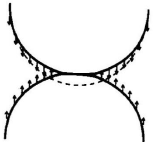
DMT model

The Derjaguin-Muller-Toporov model (DMT)

For more reading consider

Muller V. M., V.S. Yuschenko, and B.V. Derjaguin. On the influence of molecular forces on the deformation of an elastic sphere and its sticking to a rigid plane. Journal of Colloid and Interface Science, 77(1):91-101, 1980

Maugis D. Adhesion of spheres: the JKR-DMT transition using a Dugdale model. Journal of Colloid and Interface Science, 150(1):243-269,1992.

The Johnson-Kendall-Roberts Model for Cohesion

The Johnson-Kendall-Roberts, JKR, model is improved over the Hertzian contact model. The JKR model takes into account the surface energy at the contact. This theory correlates the contact area of two contacting particles to the elastic material properties and the interfacial interaction strength. The cohesive force can be formed during the unloading cycle of contact as a force resisting separation. The JKR contact model between two particles leads to the radius  of the contact zone to be described by:

a^3 =\frac{R^*}{E^*}[f_n + 3 \gamma_{sur} \pi R^* + \sqrt{6\gamma_{sur}\pi R^*f_n + (3 \gamma_{sur} \pi R^*)^2}]

where \gamma_{sur} is the surface energy in J/m^2. The separation of the two particles is obtained from a maximum tensile force given by:

f_{JKR} = -\frac{3}{2} \pi \gamma_{sur} R^*

and does not depend on the elastic moduli of the material. The total normal force of contact with cohesion can be written as:

f_n = \frac{4a^3E^*}{3R^*} - \sqrt{8 \pi E^* \gamma_{sur} a^3}

This represents a fully elastic model considering the cohesion between particles in the contact zone. The figure below provides an example of the JKR model and illustrates the tensile force between the particles in cohesive contact.

jkr

The Johnson-Kendall-Roberts Contact Mechanical Model

The JKR approximation is accurate for large cohesive energies and larger particles with low Young’s modulus. The model does not provide resistance in the tangential shearing direction. This limits the effect cohesion has on material flow as material is allowed to slide past each other with little resistance.

Johnson K. L., Kendall K., Roberts A., “Surface energy and the contact of elastic solids”, Proceedings of the Royal Society of London. Series A, Mathematical and Physical Sciences, 324 (1558), P301 – 313 1971.

Farhang R., Dubois F., Discrete-Element Modeling of Granular Materials, John Wiley & Sons Inc. 2011.

Johnson K., Contact Mechanics, Cambridge University Press, Cambridge, 1999.

The Bradley Model for Cohesion

One of the initial cohesive models was proposed by Bradley. This model neglects the deformation of contact and considers the van der Waals forces. Bradley showed that the adhesive force for rigid spheres follows a force derived from the Lennard-Jones potential—a mathematical model that approximates the interactions between a pair of neutral atoms or molecules. The force of adhesion between two rigid spheres is described by:

f_n = \frac{8\pi\gamma_{sur} R^*}{3}[\frac{1}{4}(\frac{\delta_n}{\delta_0})^{-8}-(\frac{\delta_n}{\delta_0})^{-2}]

where \delta_0 is the equilibrium separation distance between the particles [1]. Two particles separate when the forces pulling the particles is reached at \delta_n = \delta_0. This model uses the van der Waals forces as the interaction creating the cohesive force. At the macroscopic scale, these forces are negligible when compared to the gravitational force experience by the particles. The figure below provides an example of the Bradley cohesion model and illustrates the attraction force between particles at a distance.
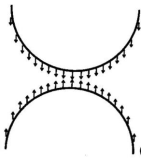
bradley

The Bradley Model [2]

[1] Bradley R. S. “The cohesive force between solid surfaces and the surface energy of solids”, Philosophical Magazine, vol. 13, no. 86, pp. 853-862, 1932.

[2] Farhang R., Dubois R., Discrete-Element Modeling of Granular Materials, John Wiley & Sons Inc. 2011

The Hertzian Contact Stress Theory

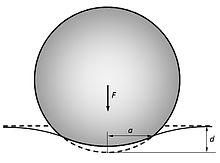
The Hertzian contact theory calculates the contact area and pressures between to surfaces. As two objects come into contact, under loading, the solids deform and a contact area is formed as shown:

contact_sphere-plane

Contact area of a solid under an applied force [1].

The contact theory allows for the estimation of the resulting contact area, pressure, and stress in the solid. The assumptions behind the theory are that the solid is elastic, surfaces friction-less, and the strains are small. These assumptions allow us to imply that the contact area is much smaller than the radius of the contacting solid. For a sphere contacting a plane, the area can be approximated as described in Contact Area of Particle-Plane Impact

Depending on the shape of the two contacting bodies, the approximation of the contact area can differ. In general form, the normal load applied over the contacting bodies is the force, F, applied over the area. With the loads and area established, the stresses on the bodies can be calculated along the major coordinate axes as principle stresses. The dominant stress will occur along the axis the load is applied and using the Mohr’s circle, the maximum shear stress can be determined.

  1. https://en.wikipedia.org/wiki/Contact_mechanics