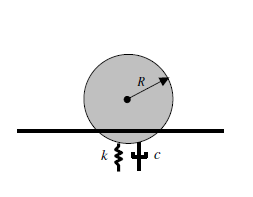
Deriving the Damping Coefficient (part 1)

damp1

m\ddot{y}\ + c\dot{y}\ + ky\ = 0          y\leq 0

This differential equation can be re-arragned as

\ddot{y}\ + \frac{c}{m}\dot{y}\ + \frac{k}{m}y\ = 0          y\leq 0

or

\ddot{y}\ + \ 2 \zeta \omega_0 \dot{y}\ + \omega_0^2\ y= 0          y\leq 0

Where \zeta is the relationship between the damping of the system relative to critical damping \omega_0 is the natural frequency of simple harmonic oscillation

critical damping coefficient,  C_{crit}\ = 2 \sqrt{km}

damping ratio, \zeta = \frac{c}{C_{crit}} \rightarrow \frac{c}{2 \sqrt{km}}

natural frequency, \omega_0 = \sqrt{\frac{k}{m}}

Therefore, \frac{c}{m} can be described by 2 \zeta \omega_0

2 \zeta \omega_0 = 2\frac{c}{2 \sqrt{km}} \sqrt{\frac{k}{m}}

2 \zeta \omega_0 = \frac{c}{\sqrt{k} \sqrt{m}} \frac{\sqrt{k}}{\sqrt{m}}

2 \zeta \omega_0 = \frac{c}{\sqrt{m} \sqrt{m}} \ = \frac{c}{m}

Solving for the general solution to this system, \ddot{y}\ + \ 2 \zeta \omega_0 \dot{y}\ + \omega_0^2\ y= 0          y\leq 0

Start by identifying the roots of the system and obtaining the general solution.

Roots of the auxiliary equation

r^2\ + \ 2 \zeta \omega_0 r \ + \omega_0^2 = 0

r = \frac{-2 \zeta \omega_0 \pm \sqrt{(2 \zeta \omega_0)^2 - 4 \omega_0^2}}{2}

r = \frac{-2 \zeta \omega_0}{2} \pm \frac{1}{2} \sqrt{4 \zeta ^2 \omega_0^2 - 4 \omega_0^2}

r = - \zeta \omega_0 \pm \sqrt{ \zeta ^2 \omega_0^2 - \omega_0^2} \rightarrow \ -\zeta \omega_0 \pm \sqrt{-1} \sqrt{ \omega_0^2 - \zeta ^2 \omega_0^2}

r = - \zeta \omega_0 \pm \omega_0 \sqrt{1 - \zeta ^2} i

General solution to the second order differential equation, \ddot{y}\ + \ 2 \zeta \omega_0 \dot{y}\ + \omega_0^2\ y= 0          y\leq 0

y(t) = e^{- \zeta \omega_0 \ t} \{Acos( \omega_0 \sqrt{1 - \zeta ^2} t) \ + \ Bsin( \omega_0 \sqrt{1 - \zeta ^2} t)\}

Simplify the notation by using \tilde{ \omega} \ = \omega_0 \sqrt{1 - \zeta ^2} and \xi = \zeta \omega_0

y(t) = e^{- \xi t} \{Acos( \tilde{ \omega} t) \ + \ Bsin(\tilde{ \omega} t )\}

Use the known condition to solve for constant A and B

Leave a comment
